
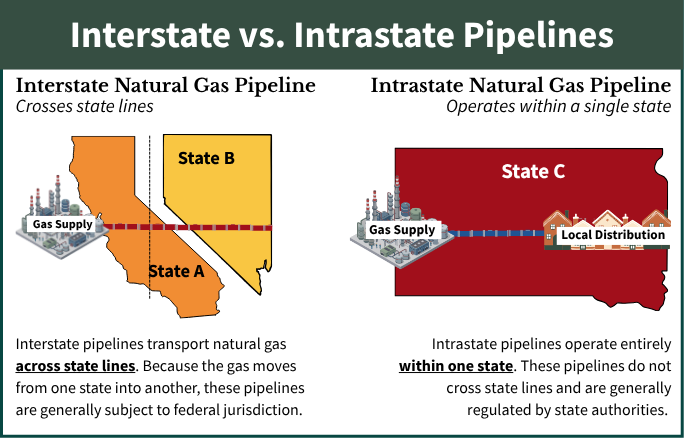
Interstate natural gas pipelines are large diameter, long-distance pipes that transport gas from the production site to processing facilities, power plants and other large users, storage facilities, and your local utility for distribution to homes and businesses. They transport gas between two or more states. Intrastate pipelines range more widely in scale. They can also be large and serve similar functions as an interstate line, but with gas received and delivered within the same state. An intrastate pipeline could also be a small local distribution line that a utility uses to serve neighborhoods.
The two types of natural gas pipelines, interstate and intrastate, are regulated in different ways, including during the construction phase. The Federal Energy Regulatory Commission regulates the siting and construction of interstate pipelines. Intrastate pipelines and their siting and construction are generally regulated by state and local governments.
There are some instances of jurisdictional overlap. In addition to its authority over interstate pipelines, FERC also has authority over the transportation services provided by certain intrastate pipelines because they are participating in the flow of gas in interstate commerce.
What are pipeline transportation services?
A pipeline’s transportation services are the services it provides to transport natural gas from one place to another for its customers. Examples include firm service (always available), interruptible service, and park-and-loan service (temporary storage within the pipeline).
What is Interstate Commerce?
Interstate Commerce refers to the economic activity of transporting goods, services, or people between and across different states.
In this case, the act of transporting natural gas across state lines constitutes interstate commerce.
In other words, even though a pipeline (1) receives gas in a particular state, and (2) delivers that gas in the same state, it may still be part of a larger pipeline network that is conducting business across two or multiple states, that is, in interstate commerce. Examples of such intrastate pipelines include Section 311 pipelines and Hinshaw pipelines: we will describe these briefly below.
Interstate Pipelines
An interstate pipeline transports gas across state lines or in interstate commerce. FERC regulates the construction, operation, siting, and abandonment of interstate pipelines under the Natural Gas Act, and this includes post-construction restoration of land. FERC also treats related facilities along the pipeline—such as compressor stations—as part of the interstate pipeline system. FERC also regulates the rates, terms and conditions of pipeline transmission service. Once an interstate pipeline is complete and in-service, the safety oversight largely shifts to another federal agency, the Pipeline and Hazardous Materials Safety Administration (PHMSA). PHMSA is the federal pipeline safety agency.
OPP has a dedicated webpage to help you track major interstate pipeline cases from around the country, what we call “priority projects.” Please check it out at www.ferc.gov/projects.
Intrastate Pipelines That Are Not Subject to FERC’s Jurisdiction
An intrastate pipeline is a pipeline that transports gas only within one state. If the pipeline does not provide interstate transportation services, it will not need FERC review and will be regulated by state or local officials, including as to both construction and operation. We at the Office of Public Participation at FERC sometimes receive inquiries about intrastate pipeline construction because some of them are major projects. However, such questions should be directed to the state or local entity with oversight authority, such as the state utility commission.
Intrastate Pipelines That Are Partially Subject to FERC’s Jurisdiction
Section 311 Pipelines
A Section 311 pipeline is one that is usually regulated by the state, but when it transports gas for an interstate pipeline or for a local distribution company served by an interstate pipeline, it becomes subject to limited FERC authority under section 311 of the Natural Gas Policy Act. Section 311 pipelines help transport natural gas within a single state as part of broader interstate transportation—often serving as the final in-state ‘leg’ of an interstate transportation effort. When moving gas in this way, it must make filings at FERC to ensure that the rates it is charging for pipeline transportation services are fair and equitable and that its operating conditions are appropriate. Section 311 pipelines are typically owned by a pipeline company.
Hinshaw Pipelines
A Hinshaw pipeline is a state-regulated, in-state pipeline that is generally exempt from FERC jurisdiction under the Natural Gas Act because the gas is received and consumed within that same state. However, if a Hinshaw pipeline wants to sell or transport gas in interstate commerce, it must obtain FERC authorization to do so, which means it becomes subject to limited FERC oversight for its interstate service. Hinshaw pipelines are typically owned by local distribution companies, the gas utilities that serve consumers in your state.
For more information about the construction or expansion of interstate pipeline projects, pipeline transportation rates, interstate pipeline tariffs, or any other filings related to an interstate pipeline, search FERC’s eLibrary. If you need help locating filings for a pipeline, need additional information, or aren’t sure whether a pipeline is subject to FERC jurisdiction, please contact the Office of Public Participation (OPP). Please also check OPP’s pipeline priority projects page, www.ferc.gov/projects, for information and status on certain major pipeline projects.