
Item E-1, Docket Nos. EL25-49-000, et al.
Today’s order directs reforms that deliver a commonsense outcome: if a new large load wants to connect directly to a power plant and operate in a way that lowers grid costs, we should let it. If the current rules don’t let this work in a way that’s fair for everyone, we must change those rules to deliver the cost savings that consumers so badly need and ensure reliable electricity for all. Saying no to innovation is not a winning strategy—whether we’re trying to win the AI race, bring back American manufacturing, or deliver the reliable and affordable energy on which families and small businesses depend.
While today’s outcome is commonsense, like so many Commission policies, the order includes a lot of regulatory jargon, which is necessary for technical precision and legal durability. That being the case, I write separately to explain what we are doing and, importantly, why we are doing it.
Let’s begin by explaining the problem that we are trying to solve. We are trying to meet surging demand while upholding two fundamental values that underpin the electric industry in our country: first, that all customers have a right to receive electric service on a timely basis, and second, that electric service should be reliable and affordable for all customers. Given the scale of new large loads putting demand on our grid today, it is clear that fostering both of these values requires intervention. Unfortunately, it has become persistently difficult and increasingly expensive to build new grid infrastructure in this country. Because of this, a business-as-usual approach to load growth—planning for generation and load separately—will not suffice to timely meet growing demand while also keeping prices reasonable.
Today’s order helps break the logjam. It directs PJM to establish new pathways for co-location—directly connecting a large load with the power needed to serve it at the same site—and load flexibility that enable large co-located loads to reduce how much they lean on the grid, while ensuring that they pay their fair share. As a result, PJM can avoid constructing unnecessary transmission upgrades for large loads, reduce strain on the grid, and make power bills cheaper for everyone—including for families and small businesses. And co-located large loads and generators can get online faster and easier than would otherwise be the case. Grid operators like PJM should allow and encourage large loads and generators to pursue these time- and cost-saving co-location arrangements. Here’s how we get there.
First, today’s order directs PJM to create two new transmission services, which we call Firm and Non-Firm Contract Demand Transmission Service. These services allow a load that is co-located with a generator to contract and pay for service from the grid consistent with the load’s actual net withdrawals, while ensuring that the load cannot take more service than the contracted amount.
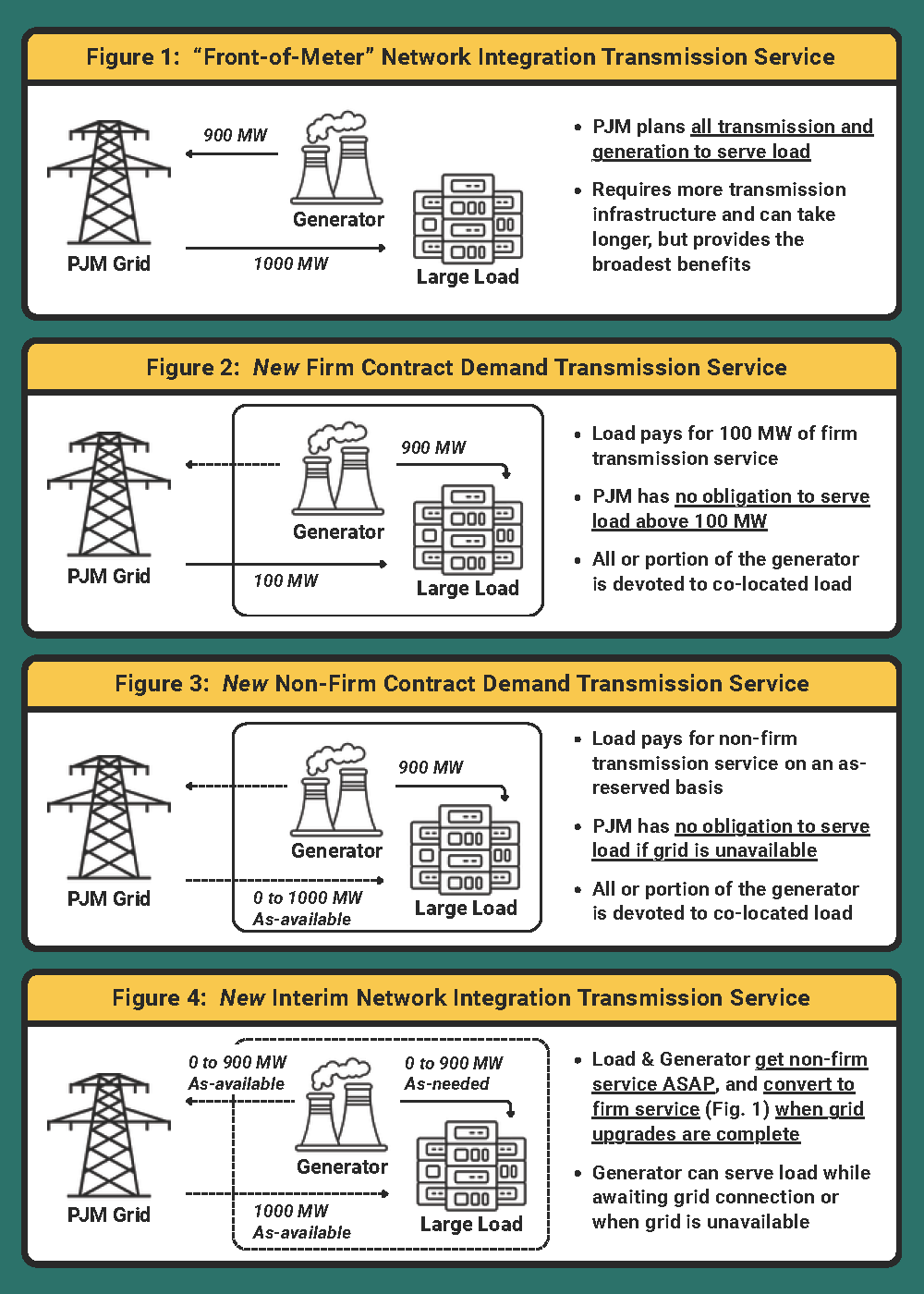
For example, consider a 1,000 MW data center that co-locates with a new 900 MW generator. Under PJM’s status quo rules, the data center would be required to take the full 1,000 MW of “front-of-meter” transmission service (see Figure 1), despite being directly connected to the co-located generator. Under today’s order, the data center has two new options:
The data center may elect to purchase Firm Contract Demand Transmission Service if, for example, it plans to take just 100 MW of firm transmission service from the grid and get the remaining 900 MW of energy it needs from the co-located generator (see Figure 2). In turn, PJM will plan enough transmission and procure enough capacity to serve only that 100 MW.
The data center may instead elect to purchase Non-Firm Contract Demand Transmission Service if, for example, it only plans to pull energy from the grid temporarily while its co-located generator is undergoing scheduled maintenance (see Figure 3). When the data center chooses non-firm service, PJM will not plan any additional transmission or purchase any capacity to serve that load.
Under either new transmission service, the co-located load must uphold its side of the bargain by bearing the risk of being curtailed if its usage exceeds what it has contracted for in advance. Therefore, regardless of whether a customer takes the new firm service, the new non-firm service, or some combination of the two, PJM will plan less transmission and procure less generating capacity for the data center, which reduces costs for both the new co-located load and for all other PJM customers and creates the opportunity for both the new generator and the new load to get online more quickly.
Second, today’s order directs PJM to revise its generator interconnection rules to clarify how both new and existing generators may co-locate with load, with a particular emphasis on accelerating new generation.
For new generators, the order directs PJM to clarify that a generator may request a level of service that is consistent with its actual injections to the grid, net of a co-located load. Consider the example above, but in reverse. If a new 1,000 MW generator co-locates with a new 900 MW data center, that generator will be allowed to “reserve” 900 MW to directly serve the data center, and will thus request to inject only 100 MW onto the PJM grid. As a result, new generators with co-located load will need fewer transmission upgrades to access the grid, allowing much-needed electricity to get online more quickly and affordably. Furthermore, the order directs PJM to file these rules for new generator interconnection within 30 days. In sum, these changes will make “bringing your own new generation” co-located with new load cheaper and faster, benefiting the generator, the large load it will serve, and—critically—all other PJM customers.
For existing generators, today’s order directs PJM to clarify that a generator cannot remove its capacity from the grid to serve a co-located load until all transmission upgrades needed to maintain reliability are in service, with the costs of those upgrades allocated 100% to the existing generator. This means that generators comprising the keystone of today’s grid cannot abandon existing customers unless and until those generators and their large load customers—not other ratepayers—construct the transmission upgrades and incur the costs necessary to maintain reliable service for everyone. And under any of the new transmission services, the large load will also pay its fair share for any benefits it continues to draw from the grid after the co-location arrangement is set up.
Third, today’s order protects existing customers—including families and small businesses—by directing PJM to assign transmission costs to ensure that a co-located load, such as a data center, always pays its fair share. A co-located load that does not withdraw energy from the grid will pay for at least the essential grid services on which it still relies (i.e., regulation and black start services). Meanwhile, a co-located load that has the same right to withdraw energy from the grid as a conventional front-of-meter load will take and pay for the full cost of traditional network transmission service. And for all options in between, a co-located load will pay a fair rate that is commensurate with its actual usage of the grid, protecting other customers from unfair cost shifting and price increases. Unless a load and its generator are completely disconnected from the grid, they will get benefits from the grid—and today’s order ensures that they will pay for those benefits.
Fourth, today’s order directs PJM to establish a new interim service (see Figure 4) to provide a bridge while the infrastructure needed to serve a large load with traditional front-of-meter network transmission service is being built. This interim service leverages speed in the near-term and unlocks the benefits of a full grid connection in the long-term. It will allow co-located loads and generators seeking front-of-meter service to access the grid faster than they can today. In exchange for increased speed, these loads will bear the risk of being curtailed when the grid is constrained until the transmission upgrades needed to provide service are constructed. But that doesn’t mean that the load will always have to shut down completely during peak periods. Rather, if the co-located load is paired with a new generator, and that generator is still waiting to begin its own front-of-meter service, the load can take service directly from the generator in the interim until both “graduate” to full, front-of-meter service. This pathway is important because traditional, front-of-meter network transmission service provides the broadest benefits to both load and generators—a network load can be served by any generator on the grid, and a network generator can sell its power to any customer on the grid.
Fifth, today’s order encourages further progress on solutions beyond co-location to keep up with growing electricity demand by directing PJM to provide the Commission with a detailed report that describes its ongoing initiatives to reduce both technical and financial barriers to building new generation and efficiently connect large loads. Given PJM’s announcement yesterday that its 2027/2028 Base Residual Auction was short of its reliability requirement, the solutions enabled by both today’s order and PJM’s ongoing initiatives to accelerate new generation are immensely important and urgent. The information PJM will file allows the Commission to monitor PJM’s progress and ensure that any further Commission actions on large load issues in the PJM region skate to where the puck is going. To that end, Secretary Wright recently asked the Commission to consider a range of “potential reforms to ensure the timely and orderly interconnection of large loads to the transmission system.”[1] Although the Secretary’s initiative is broader than both co-location and PJM, I am pleased that today’s order makes major progress on the important matters that he referred to the Commission.
Finally, all of the Commission’s actions in this proceeding respect the long-standing jurisdictional line between federal and state authority provided by Congress and affirmed by the Supreme Court. Co-located loads will continue to receive a bill for state-regulated retail service just like any other load. Moreover, states retain exclusive jurisdiction to allocate how the costs of FERC-jurisdictional transmission charges are divided between their retail ratepayers, including co-located loads. The difference today’s order makes is that utilities and load-serving entities will now have access to new transmission service options that will help lower costs for everyone.
Today’s order is just the next step on important work that the Commission cannot do alone. I encourage all parties to approach today’s order, and the path forward that it directs, with an open mind. Durable consensus requires your collective expertise to implement a solution capable of meeting today’s challenges, realizing the historic opportunity that load growth presents, and delivering the reliable and affordable energy on which we all depend. Our country deserves no less.
For these reasons, I vote to approve today’s order.
________________________
David Rosner
Commissioner
[1] U.S. Department of Energy, Secretary of Energy, Direction that the Commission Initiate Rulemaking Procedures and Proposal Regarding the Interconnection of Large Loads Pursuant to the Secretary’s Authority Under Section 403 of the Department of Energy Organization Act (Oct. 23, 2025).