
The electric industry is in the midst of changes not seen in a generation. Compared to more traditional load growth, the large loads seeking to connect to the grid today are larger, sometimes by orders of magnitude, and more concentrated. They also exhibit different operational characteristics, such as the ability to quickly change their energy consumption, sometimes in seconds. Often, these large loads seek to connect to the grid as quickly as possible. And because of these dynamics, large loads are rapidly driving the need for new transmission infrastructure and energy supply. This creates new challenges that, if unaddressed, could jeopardize the reliability and affordability of the grid on which we all depend.
Today, we are taking an important step toward addressing these challenges. We are opening a dialogue with each of the six RTO/ISOs on a series of reforms that are tailored to address the unique reliability and affordability challenges posed by large load growth and the infrastructure buildout needed to serve dramatically growing demand. Informed by the record developed in response to the Secretary of Energy’s October 2025 ANOPR,[1] and by innovative proposals that stakeholders have filed with the Commission under FPA section 205, today’s orders are aimed at ensuring that the grid remains reliable and affordable for all customers, especially residential customers. It is also crucial that we unlock the immense economic opportunity that once-in-a-generation growth represents. While each order’s specific focus varies according to the progress that each RTO/ISO has made, our actions today fit broadly into four key pillars that, taken together, provide a foundation for durable reform.
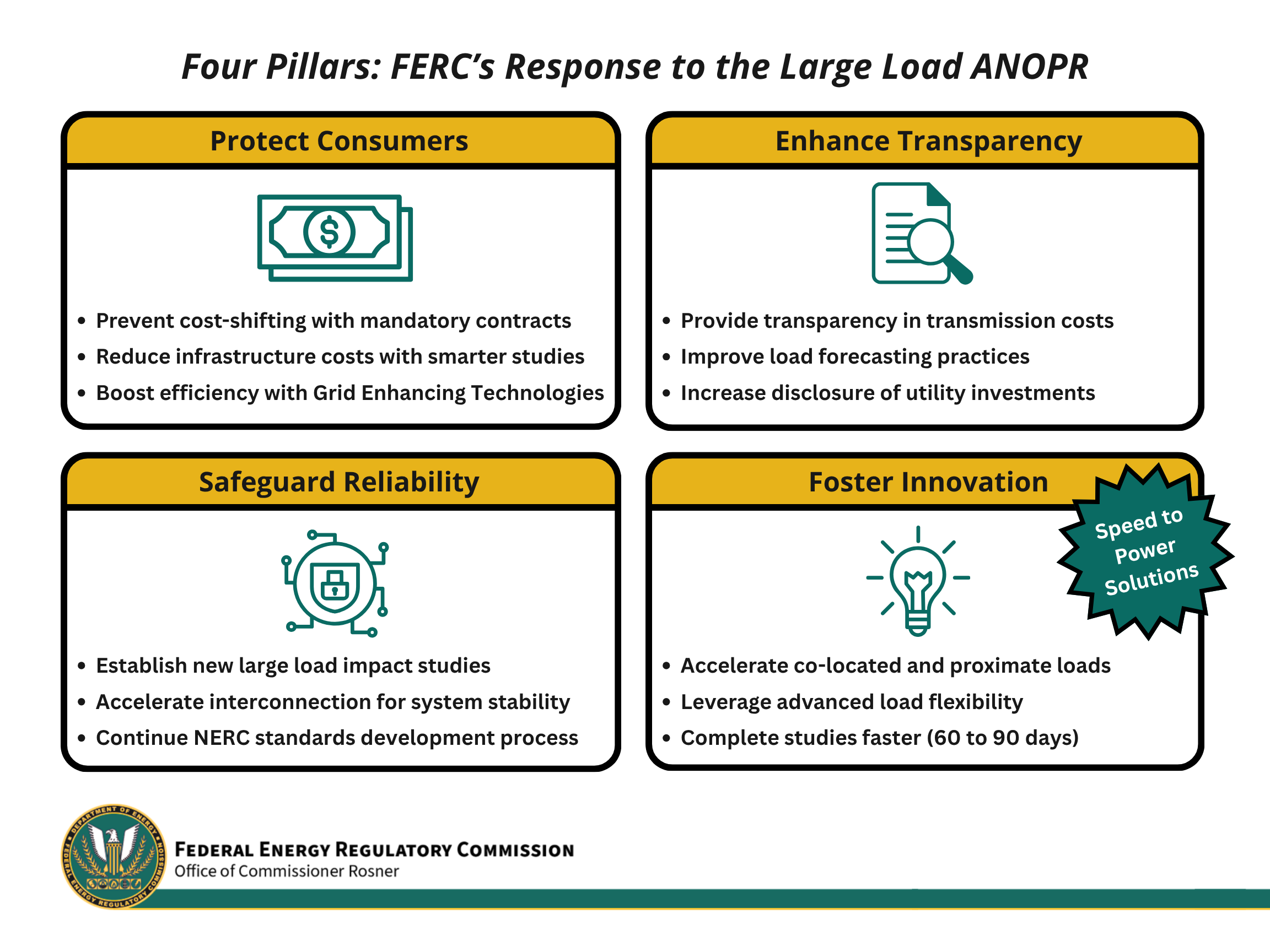
Today, we are: (1) Protecting Consumers, (2) Safeguarding Reliability, (3) Enhancing Transparency, and (4) Fostering Innovation (see Figure 1). I write separately to explain how.
Protecting Consumers: Today’s orders include key protections that promote affordability. First, today’s orders require “Cost Recovery Agreements”, which are designed to ensure that large loads pay their fair share of the costs incurred to serve them, regardless of whether the large load comes online as planned. Thus, if new infrastructure is built to accommodate a data center, and that data center doesn’t show up, residential customers are not left on the hook to pay the costs. Cost Recovery Agreements prevent those costs from being shifted to residential customers. Depending on how they are structured, Cost Recovery Agreements can also address the potentially uneven pacing of new infrastructure costs, where grid upgrade costs may hit customer bills before the large load is fully online and energized. Data centers have committed to paying their own way.[2] Today, with “Cost Recovery Agreements,” we are taking steps to ensure that those commitments are honored. I note, however, that the door remains open to other creative, regionally-specific ideas to protect consumers. If there are other ways to accomplish that goal, I welcome those proposals.
Another win for consumers is requiring RTO/ISOs to consider grid enhancing technologies (GETs), including dynamic line ratings, when adding new large loads to the grid. GETs are technologies that squeeze more juice out of the existing grid, reducing the need for expensive upgrades and speeding up the time connect. Ensuring that RTO/ISOs consider GETs in the planning process—and if GETs are not used, explain why—not only helps new large loads get connected more quickly, but is also a commonsense step towards saving all consumers money. Put differently, today’s orders will help us understand if we are leaving efficiencies on the table, an outcome we cannot afford.
Safeguarding Reliability: Today’s orders safeguard reliability. They help ensure that RTO/ISOs use study procedures and operational requirements that reflect large loads’ unique characteristics and the reliability impacts of connecting them to the grid. Those novel characteristics and reliability impacts are well-documented, and it is not clear if existing study procedures or operational requirements account for them. Clear, comprehensive, and specifically tailored study procedures and operational requirements are needed, such as enhanced data reporting and telemetry to increase visibility into how these loads interact with the grid, and today’s orders represent progress towards this goal.
Finally, although not part of today’s orders, I want to highlight NERC’s ongoing efforts to establish registration criteria for large computational loads and to develop reliability standards.[3] NERC’s goal is to finish the first phase of this critical work this year. It is essential that NERC meet this deadline. I encourage all stakeholders to participate in NERC’s process.
Enhancing Transparency: Today’s orders provide regulators—the Commission and, critically, our state partners—and customers with data on how connecting large loads to the grid affects bills. Today’s orders embody a commonsense approach: if a Network Upgrade is built to connect a large load to the grid, consumers should know who that upgrade was built for and what it cost.
Transparency is important because “who pays?” has been and continues to be a fraught and contentious question for large load interconnection. Stakeholders, including state regulators and the ratepayers that they represent, must know the costs, for whom they are being incurred, and how they are being allocated, to know that everyone is paying their fair share. Today’s orders ensure that this information is public, accessible, and clear. State regulators in more than half of the country have enacted large load tariffs.[4] Our action today helps them as they continue their critically important work.
The Commission’s action today also addresses speculative load interconnection requests, which clog up load interconnection queues, divert resources, and distort forecasts. Under current rules, data centers can (and are incentivized to) “shop around” their prospective projects with different utilities to identify the fastest and cheapest location to connect. This wastes time and resources studying projects that are not real. Worse yet, it can inflate expected load growth by modeling projects that do not materialize, leading to double counting, inaccurate market signals, and unnecessarily high prices for consumers. Today, we target speculative projects by establishing escalating readiness requirements for distinct phases of the study process to deter duplicative or speculative requests for transmission service. I strongly encourage RTO/ISOs to pursue other improvements to load forecasts, such as using objective screening criteria like physical site control, to ensure that the data used to plan the grid is as accurate as possible.[5]
Fostering Innovation: As I have said, to meet the moment, “a business-as-usual approach . . . will not suffice.”[6] Building new infrastructure is difficult and costly, which delays efforts to connect large loads to the grid quickly, reliably, and cost effectively. This is doubly true when generation and load are planned and studied separately. Today’s orders push beyond this status quo.
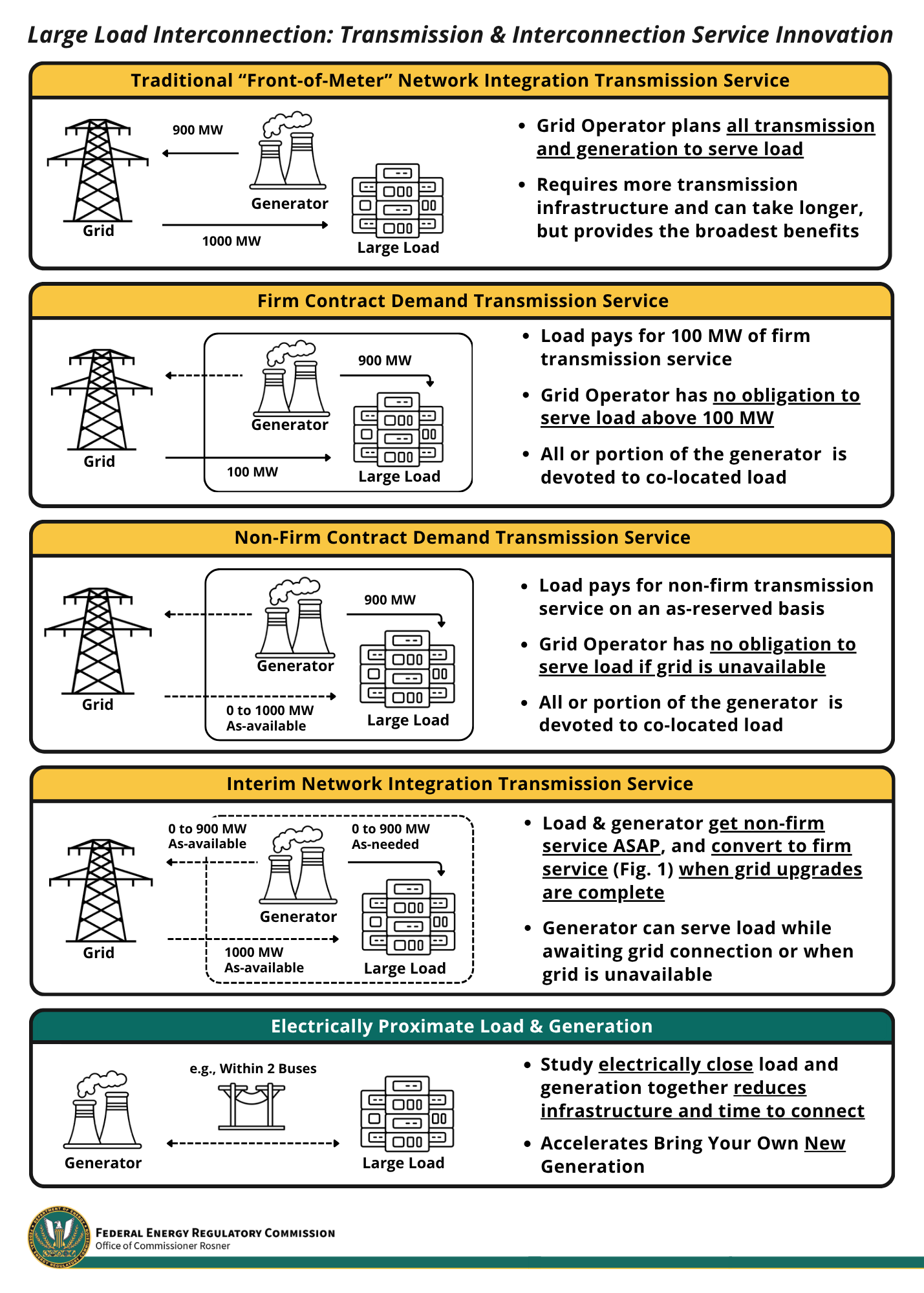
First, today’s orders promote flexible transmission services—that is, non-firm service to a co-located load that is willing and able to limit withdrawals from the grid—in every RTO/ISO (see Figure 2). As we explained when we first created these transmission services in PJM for co-located loads, customers willing to embrace flexibility can reduce the need for Network Upgrades and generating capacity to serve a co-located load, which speeds up connecting to the grid and reduces costs for the co-located load as well as other retail customers.
Second, today’s orders recognize that extending these same transmission services to large loads that are not co-located but that may also be willing to limit their withdrawals from the grid can unlock even more efficiency. Just as for co-located loads, legalizing flexible transmission service options for more large load customers can speed interconnection, avoid constructing unnecessary transmission upgrades, reduce strain on the grid, and make power bills cheaper for everyone.
Finally, today’s orders embrace yet another innovation. Load and generation need not be co-located to reduce the number of Network Upgrades; in other words, literal co-location is not the only way to facilitate faster, more efficient, and more cost-effective connections to the grid. Rather, where a large load and an associated generator are electrically proximate (i.e., close together) and studied together, the reliability impacts on the grid may be more limited than if the load and generator are studied separately. Just like with co-location, more limited impacts on the grid mean, all else equal, fewer Network Upgrades, which makes connecting to the grid faster, more efficient, and cheaper for both the large load and the associated generator. That last point is key. To add new supply to the grid, we must create incentives for “Bring Your Own New Generation.” Today’s orders make BYONG faster and more efficient.
SPP has been a leader in showing how to push beyond the status quo. With its innovative HILLGA proposal, approved by the Commission in January,[7] SPP leveraged the opportunity for speed and efficiency by studying load and generation together, and by creating a limited, expedited interconnection service to connect faster. By matching the generator’s output to the electrically proximate large load’s demand, the impacts to the grid are less than they otherwise would be, minimizing the need for time-consuming and costly Network Upgrades needed to connect. HILLGA is one solution that works for SPP, but today’s orders direct other regions to follow SPP’s lead in ways that work for them. Today’s orders add a key tool by ensuring that all RTO/ISOs can study load and generation together.
The Commission’s action today is an important step forward, but the Commission cannot accomplish this work alone. States are essential partners in this work. The Commission’s actions here respect the long-standing jurisdictional line between federal and state authority provided by Congress and repeatedly affirmed by the Supreme Court. States retain exclusive jurisdiction to allocate the costs of FERC-jurisdictional transmission charges among their retail ratepayers, including co-located loads. States also hold the keys to energy infrastructure permits, so we rely on their decisions to ensure that needed transmission and generation get built. At a time when some large loads are retail customers that can consume as much energy as a small city, it is imperative that we work within our respective jurisdictions, but that we collaborate. I look forward to continued collaboration.
Today’s orders begin an important dialogue with RTO/ISOs. As a potential next step, today’s orders invite RTO/ISOs to respond by submitting proposals under FPA section 205. I cannot encourage this enough. I also encourage public utilities outside of RTO/ISOs across the country to do the same. The electric industry is rapidly evolving with regions experiencing and addressing these challenges in different ways. Many of the examples on which the actions in today’s orders are based on stakeholders thinking creatively to develop solutions, and I welcome other new, innovative, and regionally tailored proposals that build on the four key pillars set forth today: (1) Protecting Consumers, (2) Safeguarding Reliability, (3) Enhancing Transparency, and (4) Fostering Innovation. Only by working together can we rise to the occasion and meet this once-in-a-generation moment to deliver the reliable and affordable energy on which we all depend. It will not be easy, but I remain optimistic and look forward to the path ahead.
For these reasons, I respectfully concur.
________________________
David Rosner
Commissioner
[1] U.S. Dep’t of Energy, Secretary of Energy Chris Wright, Direction that the Commission Initiate Rulemaking Procedures and Proposal Regarding the Interconnection of Large Loads Pursuant to the Secretary’s Authority Under Section 403 of the Department of Energy Organization Act (Oct. 23, 2025).
[2] See Proclamation No. 11014, 91 Fed. Reg. 11439 (Mar. 4, 2026).
[3] NERC, Large Loads Action Plan Q1 2026 Update (Apr. 2026), https://www.nerc.com/globalassets/initiatives/large-loads-action-plan/llap-quarterly-update-q1-2026.pdf.
[4] See, e.g., National Association of Regulatory Utility Commissioners Supplemental Comments at 2-6; Edison Electric Institute Supplemental Comments at App. 9-13.
[5] See Comm’r David Rosner, Letter to the RTOs/ISOs on Large Load Forecasting (Sept. 18, 2025), https://www.ferc.gov/news-events/news/chairman-rosners-letter-rtosisos-large-load-forecasting.
[6] PJM Interconnection, L.L.C., 193 FERC ¶ 61,217 (2026), (Rosner, Comm’r, concurring) at P 3.
[7] See Sw. Power Pool, Inc., 194 FERC ¶ 61,031 (2026).