
Docket Nos. ER26-414-000 & ER26-414-001
Today the Commission approves the Southwest Power Pool’s (SPP) Consolidated Planning Process (CPP), marking a major step forward for improved speed and efficiency in generator interconnection and transmission planning that promises to deliver the electrons our country so badly needs. Faced with electric demand growth at levels not seen in 25 years,[1] SPP and its stakeholders have risen to the occasion with one of the most innovative, common-sense proposals presented to the Commission since the inception of open access transmission service. This proposal will get transmission built smarter and connect new generation faster, helping to make energy more reliable and affordable in the SPP region. And it has done so with the unanimous support of both its member states and stakeholders.
CPP delivers these benefits by eliminating the silos between the transmission planning process and the generator interconnection process, synthesizing and streamlining them into one recurring three-year planning cycle. These two processes are inextricably linked: generators need transmission to sell the electricity they produce, and transmission companies build the grid and sell the transmission services that generators depend on to get their power to customers. CPP recognizes that generation and load share one transmission system, and plans for both of their needs holistically. As a result, SPP can reduce interconnection study costs by millions of dollars, potentially avoid over $100 million in duplicative transmission costs every planning cycle, [2] and at the same time deliver some of the shortest generator interconnection timelines in the country.
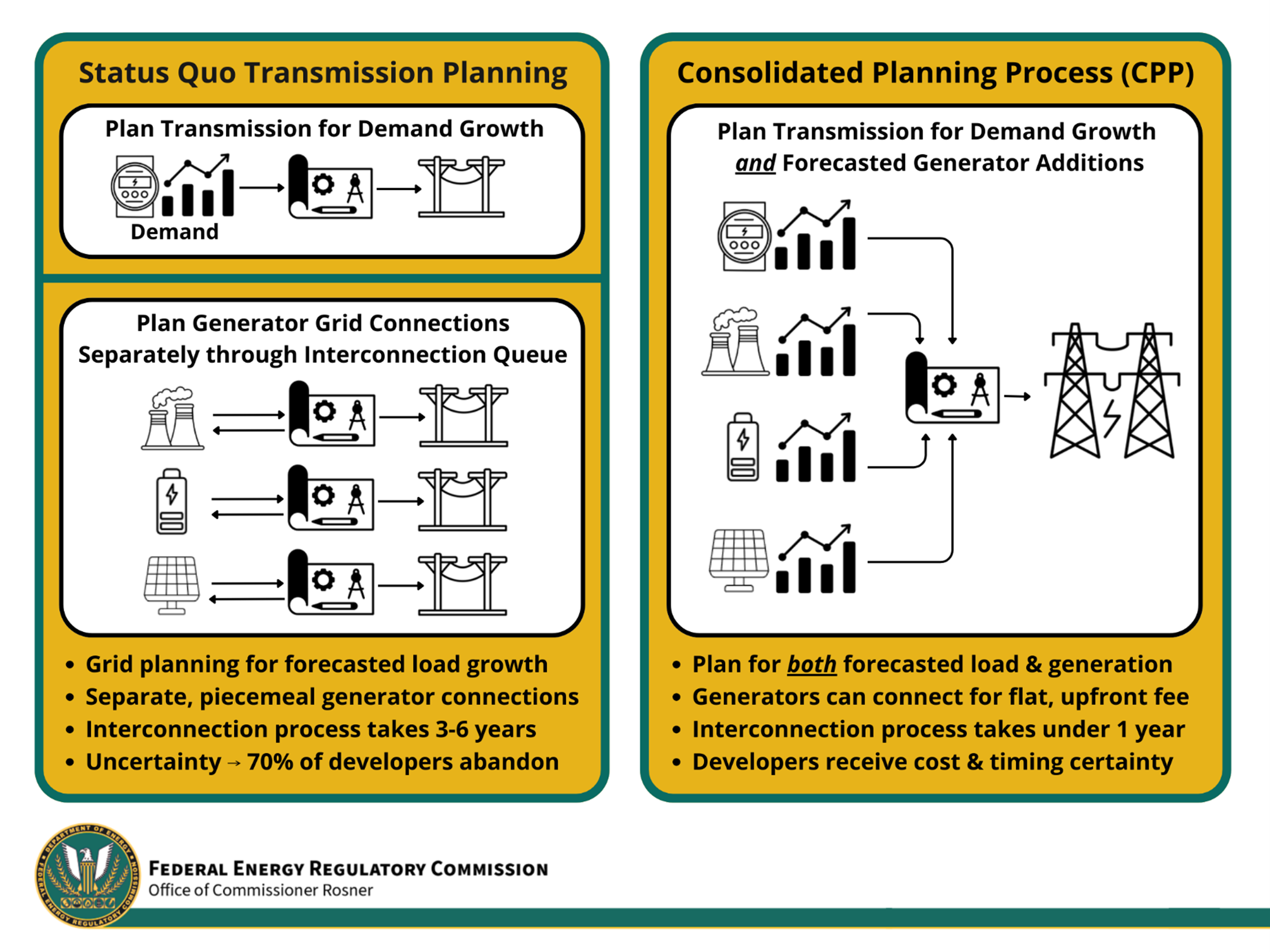
Understanding how CPP delivers these benefits requires that we review the status quo planning process in a typical region (see Figure titled “Status Quo Transmission Planning”). First, the grid operator plans the new transmission lines needed to keep the grid reliable and economically efficient given demand forecasted over the next ten to twenty years. Although planning processes include forecasted demand, by design, they typically only reflect generators that have completed the interconnection process and don’t always identify the transmission upgrades needed to integrate future, forecasted generation growth. Instead, there is a separate generator interconnection study process that identifies only the incremental grid upgrades needed to integrate each individual power plant, often resulting in studying and restudying what is needed until all prospective generators are willing to accept the cost of the transmission upgrades they need to get their individual facilities online. Because the costs of incremental transmission upgrades are unknown until the generator interconnection process is complete, over 70% of generators end up dropping out of the queues.[3] And because so many generators drop out, interconnection studies and cost estimates frequently become stale, and the grid operator has to run study after study to reevaluate what transmission will be needed, dragging out the process for three to six years.[4] As a result, it takes too long and costs too much to get a generator connected, ultimately making energy more expensive and less reliable for customers.
Enter CPP. Unlike the status quo, CPP begins with a holistic plan that identifies the new transmission lines needed to meet forecasted demand and forecasted generation over the next 20 years (see Figure titled “Consolidated Planning Process (CPP)”). Importantly, the CPP will identify planned interconnection locations (PILs), which are places on the grid with existing or planned transmission capacity available for new generators to connect to. In other words, CPP signals to generators on the front end—rather than years later—where they should interconnect to minimize costs and maximize benefits to the entire grid. SPP will then annually run a second pass of its transmission planning cycle that looks 10 years forward and allows generators to secure their spots if they want to interconnect to a PIL. Generators are required to pay their fair share into the transmission planning pot via a one-time, per-MW, upfront entry fee—the “GRID-C” charge. No power plant can obtain financing when the transmission costs are either unknown or subject to significant revision based on “that next study.” CPP solves that conundrum.
Critically, SPP publishes the GRID-C charge before interconnection requests are submitted annually. For the first time, SPP’s interconnection customers can know what they will pay to connect to the grid before entering the interconnection queue, turning the page on never-ending studies, restudies, and cost uncertainty that ultimately lead to generators withdrawing. Frankly, this shift is more than an evolution, it’s a revolution. It enables a series of other reforms in SPP’s new Interconnection Cluster Study (ICS), including: a higher up-front entry fee, one single Decision Point for generators to withdraw or move forward (instead of three today), shorter restudy times, and ultimately, an interconnection agreement within 9-10 months from the close of the application window. This timeline is more than 65% faster than the average interconnection waitlist across the country, because SPP is doing a comprehensive system analysis before fielding interconnection requests, offering generators certainty and reducing speculation - in exchange for paying fixed fees up front and allowing fewer opportunities for generators to withdraw. The record overwhelmingly illustrates that this is a trade all stakeholders are happy to make.
It is also important to note that the CPP-20 study is exactly the type of smart, efficient long-term transmission planning that the Commission intended when we developed Order No. 1920.[5] Assessing transmission needs holistically and proactively will help SPP build the backbone grid infrastructure needed to bring new power and customers online in a way that maximizes benefits and minimizes costs for consumers.
Further, none of CPP’s accelerated study processes could be achieved without modern, automated engineering study processes that leverage cutting-edge software. I have repeatedly emphasized the crucial importance of automating interconnection studies so we can connect new generation to the grid faster.[6] It is truly exciting that CPP will take another leap forward by automating long-term transmission planning along with interconnection studies.
In sum, CPP represents the innovation that America needs to facilitate cost-effective transmission buildout and generator interconnection, reduce costs, and enhance system reliability. Today’s order is a step toward building a grid that can win the AI race, bring back American manufacturing, and deliver the abundant, reliable, and affordable energy we need. I strongly encourage other transmission providers to take note of the innovative approach the CPP promises, and to consider developing similar integrated solutions tailored to meet the pressing needs within their own footprints.
For these reasons, I respectfully concur.
Figures
[1] Press Release, EIA, EIA Forecasts Strongest Four-Year Growth in U.S. Electricity Demand Since 2000, Fueled by Data Centers (Jan. 13, 2026), https://www.eia.gov/pressroom/releases/press582.php.
[2] Press Release, SPP, SPP Consolidated Planning Process to Reduce Costs and Help Meet Nation’s Growing Energy Needs (Aug. 5, 2025), https://www.spp.org/news-list/spp-consolidated-planning-process-to-reduce-costs-and-help-meet-nation-s-growing-energy-needs/.
[3] J. Rand et al., Queued Up: 2025 Edition, Lawrence Berkeley National Laboratory, at 31 (2025), https://eta-publications.lbl.gov/sites/default/files/2025-12/queued_up_2025_edition_12.15.2025.pdf.
[4] Id. at 40.
[5] Bld’g for the Future Through Elec. Reg’l Transmission Planning & Cost Allocation, Order No. 1920, 187 FERC ¶ 61,068, at PP 1625-48, order on reh’g & clarification, Order No. 1920-A, 189 FERC ¶ 61,126 (2024), order on reh’g & clarification, Order No. 1920-B, 191 FERC ¶ 61,026 (2025).
[6] See David Rosner, Comm’r., Letters to ISOs/RTOs Regarding Interconnection Automation (Mar. 17, 2025), https://www.ferc.gov/news-events/news/commissioner-rosners-letters-isosrtos-regarding-interconnection-automation; see also David Rosner, Written Testimony of David Rosner, Commissioner, Federal Energy Regulatory Commission (United States House of Representatives Subcommittee on Energy, Feb. 3, 2026).