
The Federal Energy Regulatory Commission (FERC or Commission) is an independent federal agency that regulates the siting, construction, and abandonment of interstate natural gas transmission pipelines and related facilities, as well as liquefied natural gas (LNG) terminals for export. This handout will show how members of the public may learn about these projects in a variety of ways.
In general, landowners are considered affected when a natural gas pipeline crosses through, is located on, or abuts a landowner’s property, or if they are within a half mile of a compressor station or LNG facility. Affected landowners should receive direct notice or contact from the project developers, while others, such as renters, community groups, non-profit organizations, and those indirectly affected, should not expect direct contact or notice from the project developers. Such non-landowners can rely on notices published on FERC’s eLibrary, local newspapers, and, in some cases, local public libraries or other public spaces. They may also receive information from FERC’s Office of Public Participation as part of its expanded outreach efforts for priority projects.
Notice & Outreach Under FERC’s Regulations: Landowners and Non-Landowners
| Landowners (Including Abutters) |
|---|
|
FERC regulations require that project developers notify directly affected landowners of proposed natural gas projects. 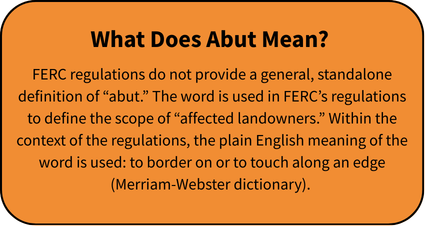
You are considered an affected landowner if:
Affected landowners can expect a project notice via mail directly from the project developers within 3 business days after FERC issues a notice of the application for the project. The notice must include:
|
| Non-Landowners |
|---|
|
FERC does not require natural gas project developers to directly notify those who are not affected landowners, such as residents or tenants (including business tenants) on affected land or the broader community. Tenants may be notified by the affected landowner or in some cases by the developer, but FERC does not require or regulate this communication. While project developers are not required to directly contact non-landowning individuals or entities, they are required to share information about the project with the public as follows:
If you are not an affected landowner, do not be discouraged. There are other avenues to learn about projects and track their proceedings. |
How can a non-landowner learn about a proposed project? Or how can a landowner get additional details? FERC offers a few options to make information accessible to all members of the public.
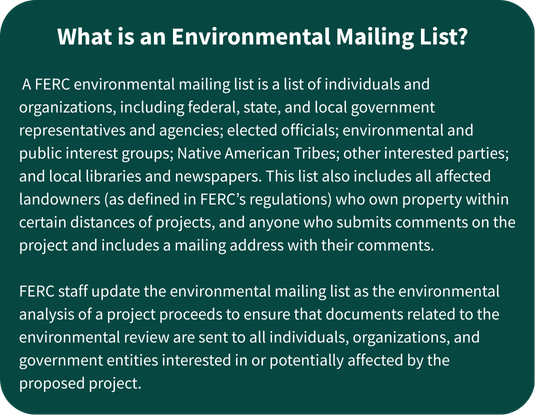
- Contact FERC’s Office of Public Participation (OPP) at 202-502-6595 or [email protected].
- If you know a project’s docket number (and if you don’t, please contact OPP for help), review FERC’s notices concerning the proposed project in eLibrary and the associated applications and environmental documents. FERC publishes the following notices to a proposed project’s docket; these may help you learn more about the project and inform your participation in the proceeding at FERC.
- Engage in the project’s proceeding by submitting a comment on the project in eLibrary and thus being added to the project’s environmental mailing list. There are several opportunities to comment in most proceedings, so you can comment multiple times if you like.
- Sign up for FERC’s eSubscription service for a project’s docket: How to eSubscribe
- Monitor FERC’s Pending Major Pipeline Projects and LNG Terminal Maps to spot activity by region or company.
- Attend project open houses and scoping sessions. OPP provides informational handouts about what to expect at open houses and scoping sessions: Natural Gas Pre-filing Open Houses: Public Participation and What to Expect and Natural Gas Scoping Sessions: Public Participation and What to Expect.