
Disclaimer: This is an educational document produced by FERC’s Office of Public Participation (OPP), pursuant to its statutory mission of providing participation support and guidance. This document does not reflect the official views of FERC, any individual Commissioner, or the United States, and you should not rely on it for legal purposes.
Introduction
Our economy and everyday lives thrive on increasing levels of electricity consumption. Manufacturing in the USA is growing. More people are switching to electric vehicles and heating equipment. Also, our digital economy is expanding with technologies like super intelligence and advanced financial products. These innovations rely on data centers and other large energy-consuming facilities, often referred to as “large loads” when their maximum demand is at least 20 megawatts.
Some large loads are located on the same site as an existing power plant — known as co-located loads, meaning the load is physically situated on the same property or immediately adjacent to the generating facility it draws from. Others are electrically proximate large loads, meaning they are not located on the same site but are connected to or served by the transmission system in close electrical distance to an existing power plant.
The interconnection of large loads, including co-located and electrically proximate loads, is expected to have significant impact on the transmission system, including grid planning and operations. The Federal Energy Regulatory Commission (FERC) is focused on leading collaborative efforts among energy stakeholders to ensure safe, reliable and affordable energy.
On June 18, 2026, FERC issued six “show cause” orders, pursuant to section 206 of the Federal Power Act, to the regional transmission organizations and independent system operators (RTO/ISOs), as well as the transmission operators in the RTO/ISO regions. The orders led to the opening of six FERC proceedings, also known as “dockets,” with one proceeding for each RTO/ISO region. Through these show cause proceedings, FERC will explore and address how large loads may interconnect efficiently to the transmission system.
Proceedings Tailored to Each Regional Market
The show cause orders, tailored to each unique RTO/ISO region, encourage each RTO/ISO to work with its transmission owners and stakeholders to address the challenges to interconnect large loads in a timely manner. Importantly, show cause orders neither make final findings nor impose new rates for transmission service. Rather, they make preliminary determinations that RTO/ISO tariffs may be unjust and unreasonable because they do not adequately address the challenges associated with integrating large loads and co-located loads onto the transmission system. FERC required RTO/ISOs to either justify their respective tariffs as just and reasonable or file reforms within 60 days (the date has now been extended to November 16, 2026, for five RTO/ISOs and to November 20, 2026, for the Southwest Power Pool, Inc. (SPP)).
The tailored show cause orders encourage each RTO/ISO to work with its transmission owners and stakeholders to address the challenges to timely interconnect large loads. This region-specific approach has the advantage of allowing each RTO/ISO to develop its unique solutions. For example, in contrast to a rulemaking that would propose uniform national standards, the show cause orders allow FERC to recognize different paths to progress in this area, such as the tariff progress already made by the PJM Interconnection, LLC (PJM) and SPP regions.
Each tailored order identifies five categories of reform for the grid operators to address.
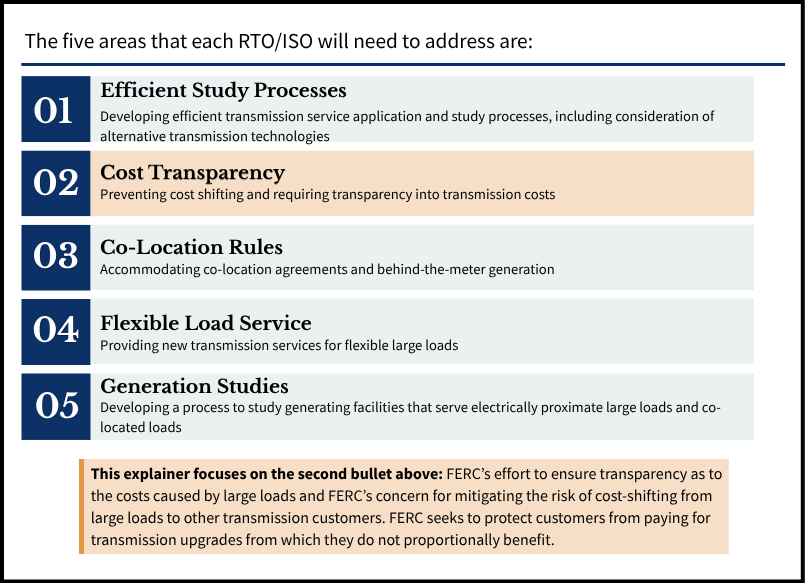
Additional Cost Transparency
FERC preliminarily found current RTO/ISOs tariffs to be unjust and unreasonable because they do not require sufficient cost transparency, which is essential to adequately protect customers. FERC stated that the RTO/ISOs do not publicly post key data about transmission system upgrades and costs associated with new service to large loads. As a possible remedy, FERC proposed that granular and detailed information be centrally posted to allow all stakeholders to better understand the nature and causes of transmission upgrade costs. That additional cost transparency would in turn allow entities like state public service commissions to track and allocate costs in accordance with their own standards for purposes of retail billing.
Cost Recovery Agreements
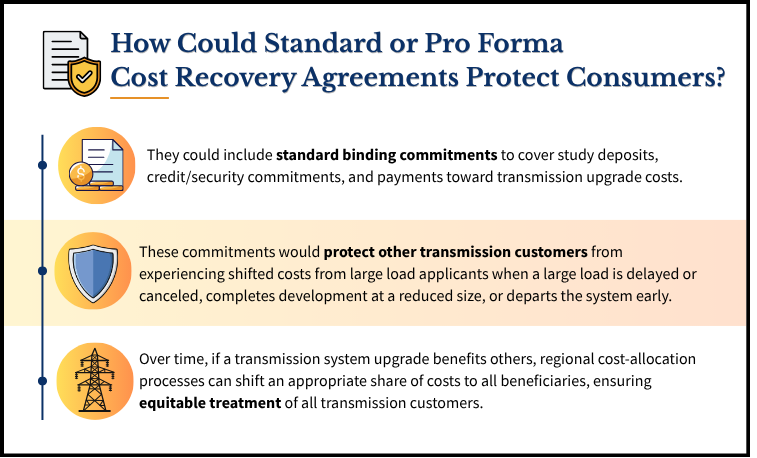
FERC preliminarily found that RTO/ISO tariffs fail to adequately protect customers of transmission service because they do not have sufficient mechanisms to reduce the risk of cost shifting among transmission customers. FERC specifically pointed to the potential need for standard, or pro forma, cost recovery agreements (CRA) among the RTO/ISO, transmission owner, and the transmission customer taking service on behalf of a large load. Note that this would likely not be a single, national cost recovery agreement and each RTO/ISO would need to explore this idea and propose its own language.
Tariff Issues and Potential Solutions in the Show Cause Orders
Rates and terms that may be unjust and unreasonable | Potential or suggested remedy |
| No public, centralized access to transparency about which network upgrades are built for which large loads, and what they cost. | Require public posting of upgrade scope, costs, and assignment; build a centralized cost transparency page on ISO/RTO website. |
| No pro forma potentially leaving stranded cost and timing risks on other customers | Adopt a standard CRA for some upfront cost recovery and financial security |
| Application/study processes for transmission service for large loads are slow/unclear; insufficient evaluation of grid-enhancing technologies | Define a large‑load application path with accelerated study timelines and explicit grid-enhancing technology evaluation |
| Missing/unclear tariff rules for co‑location & behind the meter generation (BTMG) | File clear rates/terms for co‑location and BTMG |
| No services tailored to flexible large loads (willing to curtail), and no pathway to study electrically proximate generation and load together | Offer non‑firm or contract demand services for flexible large loads; create a co‑study process for electrically proximate generation and load |
Federal and State Jurisdiction: Protecting Customers from Cost-Shifting
FERC and the states share responsibility for shielding customers from unreasonably high electricity bills resulting from large load interconnections. FERC sets the rates, terms and conditions of interstate transmission service. The transmission costs that FERC approves include costs experienced by RTO/ISOs and transmission providers to build, monitor, maintain, and operate the grid, from poles and wires, to software and hardware, to equipment and inventory of all kinds, to personnel with all manner of expertise. FERC’s approved terms for transmission service may also include cost transparency measures and standard cost recovery agreements that may be proposed in RTO/ISO tariffs, as described above.
Meanwhile, the states and local agencies have siting authority. That is, states have control over whether and where transmission lines and large loads like data centers can be sited and built. States, as well as some municipalities and electric cooperatives, also have exclusive authority over retail service and retail (end use) rate design. In particular, for state-regulated utilities, the state public utility commission determines how federally-approved transmission costs are sub-allocated among classes of retail customers, such as commercial customers and residential customers. States approve how utilities pass down those costs among different customer classes and choose whether to take into account factors such as the customer’s usage at peak times. Therefore, states need cost transparency about transmission upgrades in order to fairly allocate costs.
Many states have launched initiatives—such as their own large load tariff proceedings—to limit cost shifting and ensure that data centers and other large loads do not impose undue risks or expenses on other customer classes.
Together, federal and state actions complement each other: FERC’s measures can enhance transparency and cost recovery at the level of interstate transmission, while state policies can ensure fair allocation and ratepayer protection at the retail level.
How Do These Orders Interact With Related Initiatives?
The show cause orders recognize ongoing related initiatives, such as the actions the Commission already directed in PJM and SPP, and seek to build on those efforts. The show cause orders allow for different regional paths and operate prospectively so as not to interfere with existing arrangements and contracts.
FERC asks for input on briefing questions to address any policy gaps and invites utilities not covered by the six orders, located outside RTO/ISOs, to follow suit. In particular, FERC:
- Encourages state public utility commissions, state regulators, and state consumer advocates to explain whether the transmission cost transparency ordered is sufficient and granular enough to inform proper state-jurisdictional cost allocation.
- Asks how RTO/ISOs should structure standard cost recovery agreements as well as what implementation details should be considered and required.
- Clarifies that ongoing negotiations for large load interconnections should continue and existing commercial arrangements should be protected while reforms proceed.
- Clarifies that the rulemaking proceeding Interconnection of Large Loads to the Interstate Transmission System, RM26-4-000, on the topics of data centers, transmission planning, and state–federal jurisdiction, as directed by the Secretary of Department of Energy, remains open, including to address issues outside RTO/ISOs as needed.
How Transmission Costs Flow from FERC → Utilities → Customers
Step 1: FERC sets transmission rules and rates and allocates costs to entities that serve customers
FERC approves transmission rates and cost allocation methods in transmission tariffs. Costs are first allocated to utilities and other load-serving entities as well as other transmission system users.
Step 2: Utilities bring their allocated costs to the State PUC for re-allocation to retail customers
Utilities that serve retail customers and are regulated by the State public utility commission present their assigned costs to the commission for re-allocation by the commission to retail customer classes. This is consistent with state authority over retail bills.
Step 3: State Commissions assign transmission costs to retail bills and determine how they appear on bills
State utility commissions decide how FERC‑approved transmission costs will be allocated in rates paid by retail customers and how the costs will appear on household and small business electricity bills.
Potential New Protections for Customers
FERC seeks consideration of a Cost Recovery Agreement approach that would protect customers if a large load project is canceled or departs early. This would provide protections at Step 1 above that would also reduce costs allocated in Steps 2 and 3. RTO/ISOs may now consider adopting such an approach in their compliance filings.
Please note that the orders address RTO/ISO tariff provisions related to charging and allocating costs for necessary transmission upgrades. For areas outside of RTO/ISOs, FERC invited transmission owners such as utilities to consider developing and filing similar updates to their tariffs that address large load interconnection challenges.
Progress Initiated with the Show Cause Orders
- Resource Adequacy Reports were filed by RTO/ISOs in July 2026 and are now available on eLibrary. The resource adequacy reports describe RTO/ISO plans to increase generation capacity to match the increasing demand for electricity, also referred to as “load growth.”
- Show Cause Responses and Answers to Briefing Questions, per Commission letters granting motions to hold proceedings in abeyance for 90 days, are due to FERC by November 16, 2026, for five RTOs/ ISOs and by November 20, 2026, for SPP, with answers due 30 days after.
When Can Comments Be Submitted About Large Load Interconnection Issues?
You may participate now at the RTO/ISO level by commenting or potentially seeking to join their working groups or task forces on these issues. Some RTO/ISOs have requirements for attendance and participation. For additional information, visit each RTO/ISO’s website. OPP also has introductory guides for RTO/ISO participation, available at: https://www.ferc.gov/opp/markets-resources
You may comment now on the show cause orders or within 30 days after each of the filings is submitted in the specific dockets:
RTO/ISO | Docket No. |
| PJM Interconnection, LLC (PJM) | EL26-67-000 |
| Southwest Power Pool, Inc. (SPP) | EL26-68-000 |
| New York Independent System Operator, Inc. (NYISO) | EL26-69-000 |
| Midcontinent Independent System Operator, Inc. (MISO) | EL26-70-000 |
| California Independent System Operator Corporation (CAISO) | EL26-71-000 |
| ISO New England Inc. (ISO-NE) | EL26-72-000 |
The related rulemaking proceeding Interconnection of Large Loads to the Interstate Transmission System, RM26‑4‑000, also remains open for comments.